Can Valve's Steam Machine Change the Gaming Industry?
Valve wants to bring PC gaming into the living room in a way that feels closer to a console. You turn it on, open Steam, and play your games without dealing with Windows updates, driver problems, or building a PC yourself.
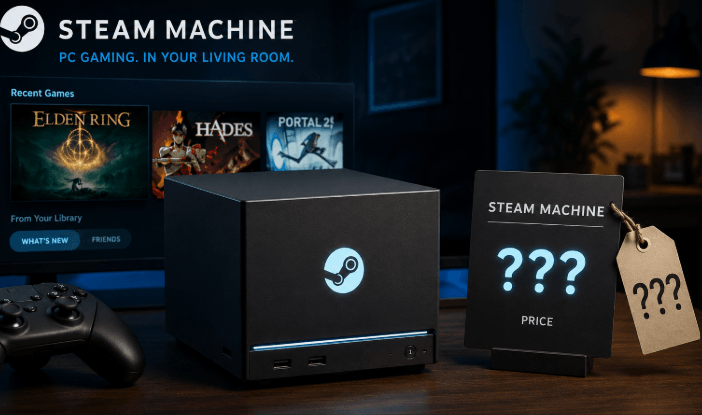
The Steam Machine is Valve’s upcoming gaming console-style PC built around SteamOS, the same Linux-based operating system used on the Steam Deck. Right now, PC gaming basically depends on Windows by default, but Valve has spent years quietly trying to change that. The Steam Deck was probably the first serious proof that gamers are willing to use Linux if the experience feels smooth enough.
The idea is simple. Valve wants to bring PC gaming into the living room in a way that feels closer to a console. You turn it on, open Steam, and play your games without dealing with Windows updates, driver problems, or building a PC yourself. If you already own a Steam library, the Steam Machine instantly has value because your games carry over. That is something consoles still struggle with across generations. Valve also benefits from Steam already being the biggest PC gaming storefront in the world. These are strong points for Valve that make it perfect for the casual customer and very consumer-friendly.
In 2015, the original Steam Machine launched and failed because PC gaming on Linux was rough, game compatibility was inconsistent. Although the failure sucked, it didnt break Valve, and it seems like they made adjustments. Today, more is in their favor. The Steam Deck sold out, twice, and AI is now strong enough to help with the compatibility issues I mentioned. The stage is set Valve to change the entire gaming industry, but there are some risk. To me, the biggest concern around the Steam Machine right now is price.
Based on current rumors and hardware leaks, the Steam Machine is expected to use a custom AMD APU significantly stronger than the Steam Deck, likely somewhere near the performance range of an AMD Ryzen 7 8700G paired with modern RDNA 3 graphics capabilities.
If the Steam Machine launches with:
- A modern AMD APU.
- High-speed RAM.
- Fast NVMe storage.
- Compact console-sized cooling.
- Console-level performance
Then the estimated price could realistically land somewhere between $700 and $1,000 depending on configuration and the current memory market.
Here is what similar PC hardware already costs on the market:
- AMD Ryzen 7 8700G: around $330.
- 32GB DDR5 RAM: around $110.
- 1TB NVMe SSD: around $80.
- Mini-ITX motherboard: around $170.
- Compact power supply: around $90.
- Small form factor case and cooling: around $120.
That already puts a comparable compact gaming PC near $900 before even accounting for:
- Valve’s custom engineering.
- Controller support.
- Wireless hardware.
- Manufacturing costs.
- Distribution.
- Profit margins.
| Consoles: | Gaming PC | Steam Machine |
| PS5 at roughly $500 | $900+ | ? |
| Xbox Series X around $500 | ? | |
| Steam Machine maybe $899 | between $700 and $1,000? |